A Lineage of Fire
Lynne Griffin as Joan
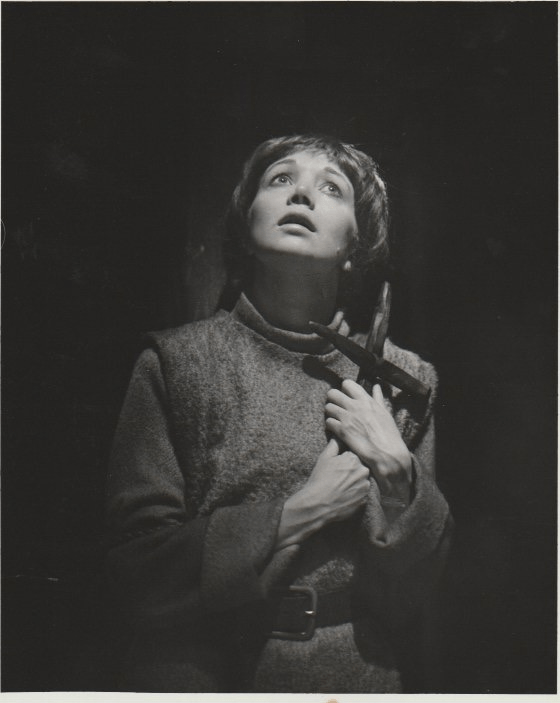
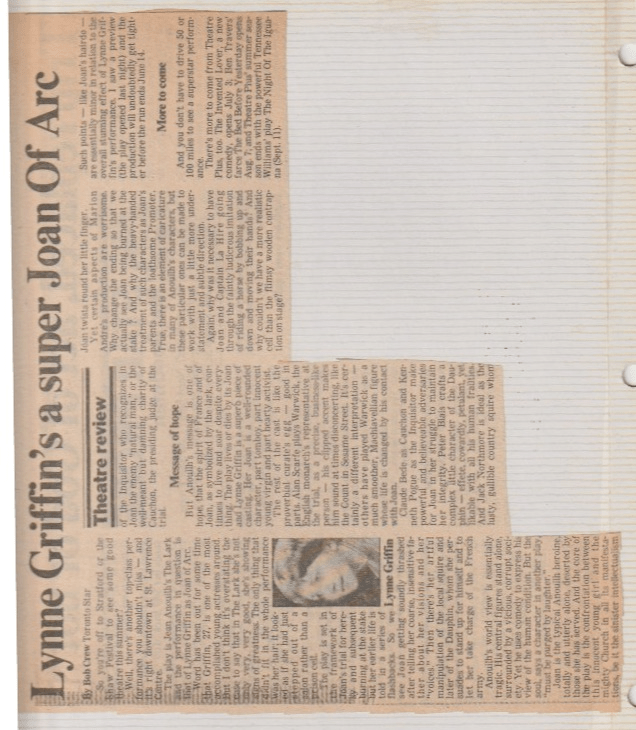
In 1980, at Toronto’s St. Lawrence Centre, Lynne Griffin ignited Canadian theatre with her radiant portrayal of Joan of Arc in Theatre Plus’s production of The Lark. Directed by Marion André, Jean Anouilh’s poetic retelling of the Maid of Orleans’ story opened on May 29—exactly 549 years after Joan’s execution in Rouen. The production was an event of rare electricity. Press materials joked that Griffin would be “burnt at the St. Lawrence stake,” and audiences and critics responded with unqualified admiration.
Griffin, then a rising young star, embodied Joan with luminous conviction. She captured both the simplicity of a devout country girl and the steel of a visionary warrior. Her performance was praised as sensitive, powerful, and utterly believable—a portrayal that connected contemporary audiences to the enduring courage of Joan’s story.
Theatre Plus’s press office declared:
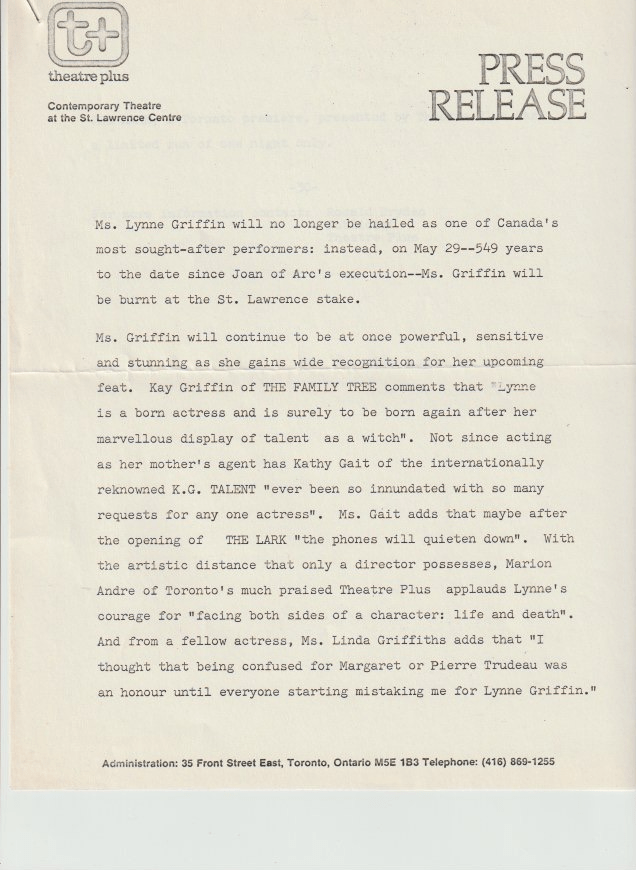
“Ms. Lynne Griffin will no longer be hailed as one of Canada’s most sought-after performers: instead, on May 29—549 years to the date since Joan of Arc’s execution—Ms. Griffin will be burnt at the St. Lawrence stake.
Ms. Griffin will continue to be at once powerful, sensitive and stunning as she gains wide recognition for her upcoming feat. Kay Griffin of THE FAMILY TREE comments that ‘Lynne is a born actress and is surely to be born again after her marvellous display of talent as a witch.’ Not since acting as her mother’s agent has Kathy Gaitt of the internationally reknowned K.G. TALENT ‘ever been so inundated with so many requests for any one actress.’ Ms. Gaitt adds that maybe after the opening of THE LARK ‘the phones will quieten down.’
With the artistic distance that only a director possesses, Marion André of Toronto’s much praised Theatre Plus applauds Lynne’s courage for ‘facing both sides of a character: life and death.’ And from a fellow actress, Ms. Linda Griffiths adds that ‘I thought that being confused for Margaret or Pierre Trudeau was an honour until everyone started mistaking me for Lynne Griffin.’”
Critical Acclaim
Reviewers and journalists quickly recognized Griffin’s performance as a breakthrough moment in Canadian theatre.
The Toronto Sun’s McKenzie Porter wrote:
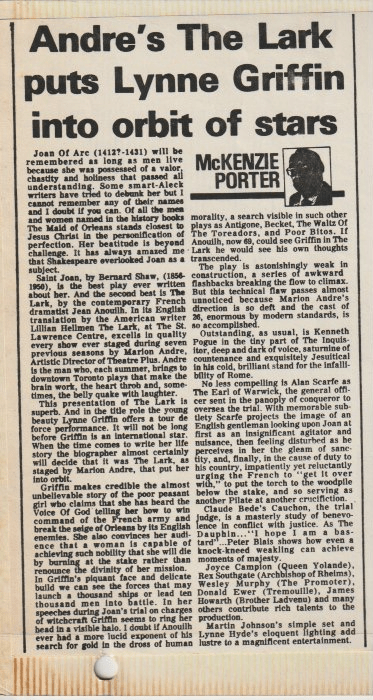
Andre’s The Lark puts Lynne Griffin into orbit of stars
Joan of Arc (1412?-1431) will be remembered as long as men live because she was possessed of a valor and chastity and holiness that passed all understanding. Some smart-Aleck writers have tried to debunk her but I cannot remember any of their names. I doubt if you can. Of all the men and women named in the history books the Maid of Orleans stands closest to Jesus Christ in the personification of perfection. Her beatitude is beyond Shakespeare’s. Shakespeare overlooked Joan as a subject.
Saint Joan, by Bernard Shaw (1856–1950), is the best play ever written about her. The second best is The Lark, by the contemporary French dramatist Jean Anouilh. In its English translation by the American writer Lillian Hellman, The Lark, at the St. Lawrence Centre, excels in quality every show ever staged during seven previous seasons by Marion Andre, Artistic Director of Theatre Plus. Andre is the man who, summer after summer, brings to southern Toronto plays make the brain work, the heart throb, and sometimes, the belly quake with laughter.
This present version of The Lark is superb. And in the title role the young beauty Lynne Griffin offers a tour de force performance. It will not be long before Griffin is an international star. When the time comes to write her life story the biographer almost certainly will decide that it was The Lark, as staged by Marion Andre, that put her into orbit.
Griffin makes credible the almost unbelievable story of the peasant girl who claimed to have heard the Voice of God ordering her how to take command of the French army and break the siege of Orleans by its English enemies. She also convinces her audience that a woman is capable of achieving such nobility that she will die by burning at the stake rather than renounce the divinity of her mission.
In Griffin’s piquant face and delicate build we can see the forces that may launch a thousand ships or lead ten thousand men into battle. In her speeches during Joan’s trial on charges of witchcraft Griffin seems to ring her head in a visible halo. I doubt if Anouilh ever had a more lucid exponent of his search for gold in the dross of human morality, a search visible in such other plays as Antigone, Becket, The Waltz of the Toreadors, and Poor Bitos. If Anouilh, now 69, could see Griffin in The Lark he would see his own thoughts transcended.
The play is astonishingly weak in construction, a series of flashbacks breaking the flow to climax. But this technical flaw passes almost unnoticed because Marion Andre’s direction is so deft and the cast of 26, enormous by modern standards, is so accomplished.
Outstanding, as usual, is Kenneth Pogue in the tiny part of The Inquisitor, deep and dark of voice, saturnine of countenance and exquisitely Jesuitical in his cold, brilliant stand for the infallibility of Rome.
No less compelling is Alan Scarfe as the Earl of Warwick, the general officer sent in the panoply of conqueror to oversee the trial. With memorable subtlety Scarfe projects the image of an English gentleman looking upon Joan at first as an insignificant agitator and nuisance, then feeling disturbed as he perceives in her the gleam of sanctity, and, finally, in the cause of duty to his country, impatiently yet reluctantly urging the French to “get it over with,” to put the torch to the woodpile below the stake, and so serving as another Pilate at another crucifixion.
Claude Bede’s Cauchon, the trial judge, is a masterly study of benevolence in conflict with justice. As The Dauphin “I hope I am a bastard” … Peter Blais shows how even a knock-kneed weakling can achieve moments of majesty.
Joyce Campion (Queen Yolande), Roy Southgate (Archbishop of Rheims), Wesley Murphy (The Promoter), Donald Ewer (Tremouille), James Howarth (Brother Ladvenu) and many others contribute rich talents to the production.
Martin Johnson’s simple set and Lynne Hyde’s eloquent lighting add lustre to a magnificent entertainment.”
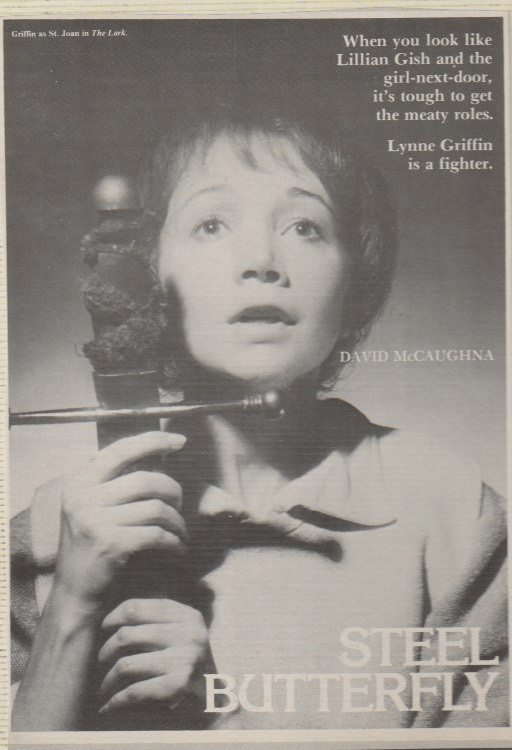
David McCaughna, in a feature titled Steel Butterfly, wrote:
“When you look like Lillian Gish and the girl-next-door, it’s tough to get the meaty roles. Lynne Griffin is a fighter.”
Joan of Arc is a great role for a young actress, and Lynne Griffin has made the most of it.
Griffin gives a strong, intelligent performance in Theatre Plus’s production of The Lark, which opened last night at St. Lawrence Centre. She is totally convincing as the simple country girl who believes she has been chosen by God to drive the English out of France, and who leads an army to lift the siege of Orleans and crown Charles VII at Rheims.
Her Joan is intense and deeply felt, but never sentimental. She has the right mixture of innocence and authority, of fervour and humour. Her trial scenes are particularly moving as she faces her judges with honesty and courage.
The Lark, written by Jean Anouilh in 1953, is a poetic drama which examines Joan’s story through a series of flashbacks. The play moves swiftly from one scene to another, covering Joan’s childhood, her meeting with the Dauphin, her victories, capture, trial and execution.
Marion André’s direction is clear and fluid, making good use of the bare stage and Martin Johnson’s simple set of wooden platforms and steps. The lighting by Lynne Hyde is evocative, and the costumes are simple and effective.
The supporting cast is excellent, with Claude Bede as Cauchon, Alan Scarfe as Warwick, Peter Blais as the Dauphin, Joyce Campion as Queen Yolande, and Rex Southgate as the Archbishop of Rheims.
There is some fine ensemble playing, particularly in the trial scenes, where the actors double as English soldiers and churchmen.
The Lark is a difficult play to bring off, but Theatre Plus has succeeded admirably, thanks to Griffin’s luminous performance and André’s skillful direction.
Scene Changes Cover Story
In June 1980, Scene Changes, Canada’s leading theatre magazine, featured Lynne Griffin on its cover. Smiling and vibrant, she appeared alongside headlines about Maggie and Pierre, Spring Thaw, and the rise of the one-man show. The caption read simply:
“Lynne Griffin, a rising young star, tackles St. Joan.”
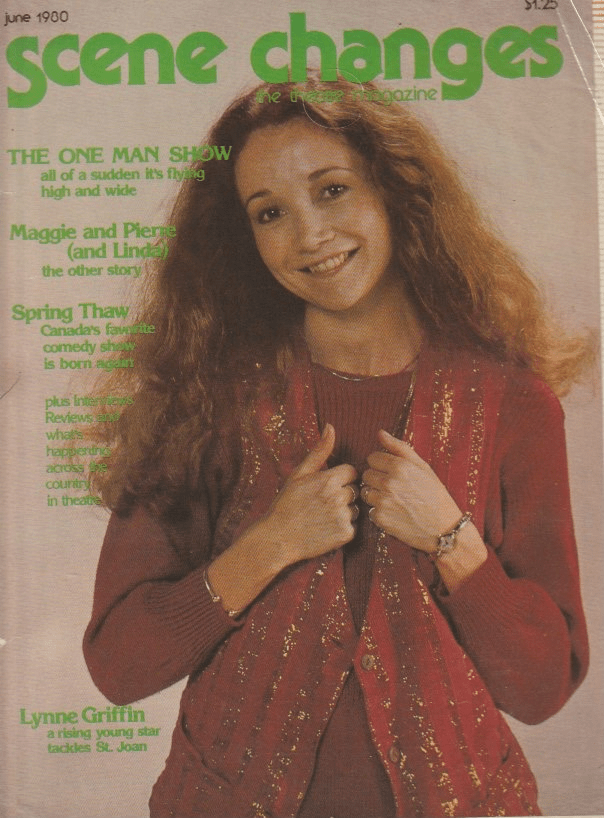
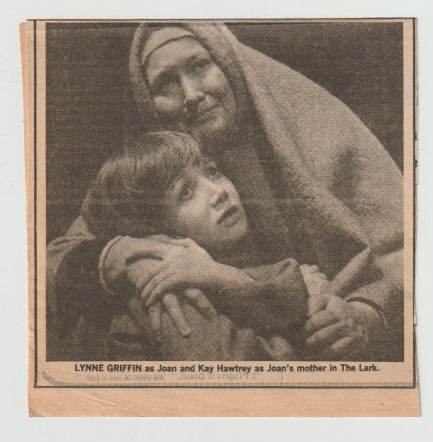
Photo Caption:
LYNNE GRIFFIN as Joan and Kay Hawtrey as Joan’s mother in The Lark.
This scrapbook of clippings and reviews preserves a vital moment in Canadian theatre history — when a young actor’s fearless performance brought Joan of Arc vividly to life for a new generation. Lynne Griffin’s Joan blazed brightly, leaving a lineage of fire for artists who followed.
 arizonatheatrematters.org
You must be logged in to post a comment.